
Step 1) Let’s start with a Kahoot to assess current knowledge of Digital Literacy!
You can access the Kahoot here: Digital Literacy Quiz
Game PIN: 01776774
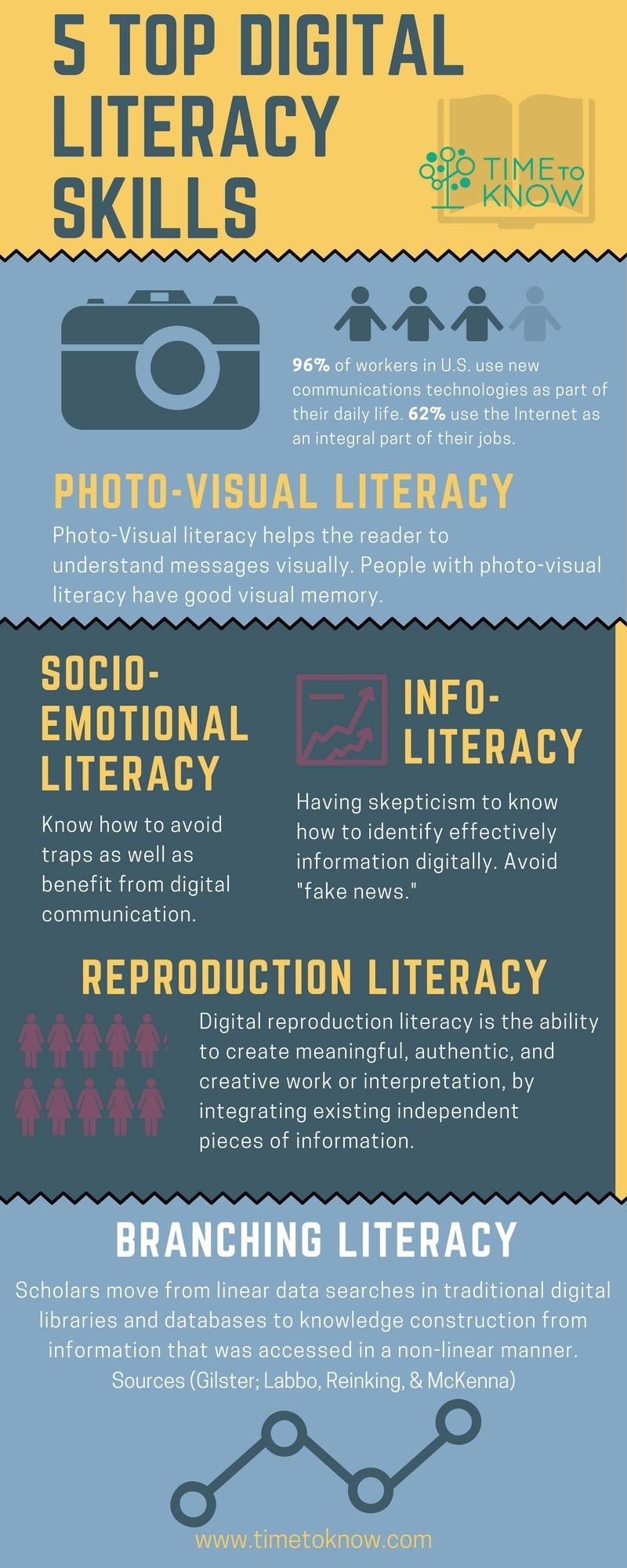
Aviram & Eshet-Alkalai (2006) contend that there are five types of literacies that are encompassed in the umbrella term that is digital literacy.
- Photo-visual literacy is the ability to read and deduce information from visuals.
- Reproduction literacy is the ability to use digital technology to create a new piece of work or combine existing pieces of work together to make it your own.
- Branching literacy is the ability to successfully navigate in the non-linear medium of digital space.
- Information literacy is the ability to search, locate, assess and critically evaluate information found on the web and on-shelf in libraries.
- Socio-emotional literacy refers to the social and emotional aspects of being present online, whether it may be through socializing, and collaborating, or simply consuming content.
Aviram, A., & Eshet-Alkalai, Y. (2006). Towards a theory of digital literacy: Three scenarios for the next steps. European Journal of Open, Distance and E-Learning.
Top Tip: Use the Referencing Handbook to correctly cite source in your blog and add it to the reference list at the bottom of your blog entries.
Step2) Self Assessment Tool
Step 3) Which type of digital learner are you?
Step 4) Digital Literacy Across the Curriculum
Step 5) Optional Twitter Task. Join/ log in to Twitter and search for ‘Digital Literacy’. This is a good way to find out what the most current debates in education are! (While you’re at it, you can follow me on @BradfordPSET!)
Step 6) Do some reading and research in preparation for your report on Digital Literacy, using the Bradford College Discover Tool. As well as search term ‘digital literacy’ refer to the key terms from the task description below e.g. ‘digital literacy in schools’ ‘ digital literacy parents/teachers/children’ and so on…
Assessment Guidance (Task 3) From the module handbook:
| 3 | Write a 500 word report on recent developments in Digital Literacy. | 12.3.20 | 15% |
“For the report you need to comment on how schools and other aspects of the education sector support the development of Digital Literacy Skills. You will need to first identify what Digital Literacy is and what training has been provided in schools to support pupils, parents and teachers. You can then consider what the future should and could be for this Digital Literacy.”
Step 7: Credibility
Not all information you find online is true. Do some internet research and reading on the topic of ‘finding credible sources’. Use this document as a self-assessment tool (before research) and to capture your learning (after reading). You can then upload this to your blog if you’d like.
You might like to include the following in your assessment of how credible a source is:
- Authority
- Accuracy
- Currency
- Coverage
Step 8: Sway Presentation: Education in the Post Truth Era. This presentation might help you learn more about credibility and information literacy in 2020 ‘The fake news era!’
Step 9: Blog! As with every session, you need to produce a short blog post reflecting on what you have learnt today. Use a reflective model (see the tab above) and use this to structure your reflection. (For extra credit, incorporate images/multimedia to make your blog post engaging e.g. for this particular post you could add the self assessment document as an attachment.)
 Ed Studies: A blog about blogging!